

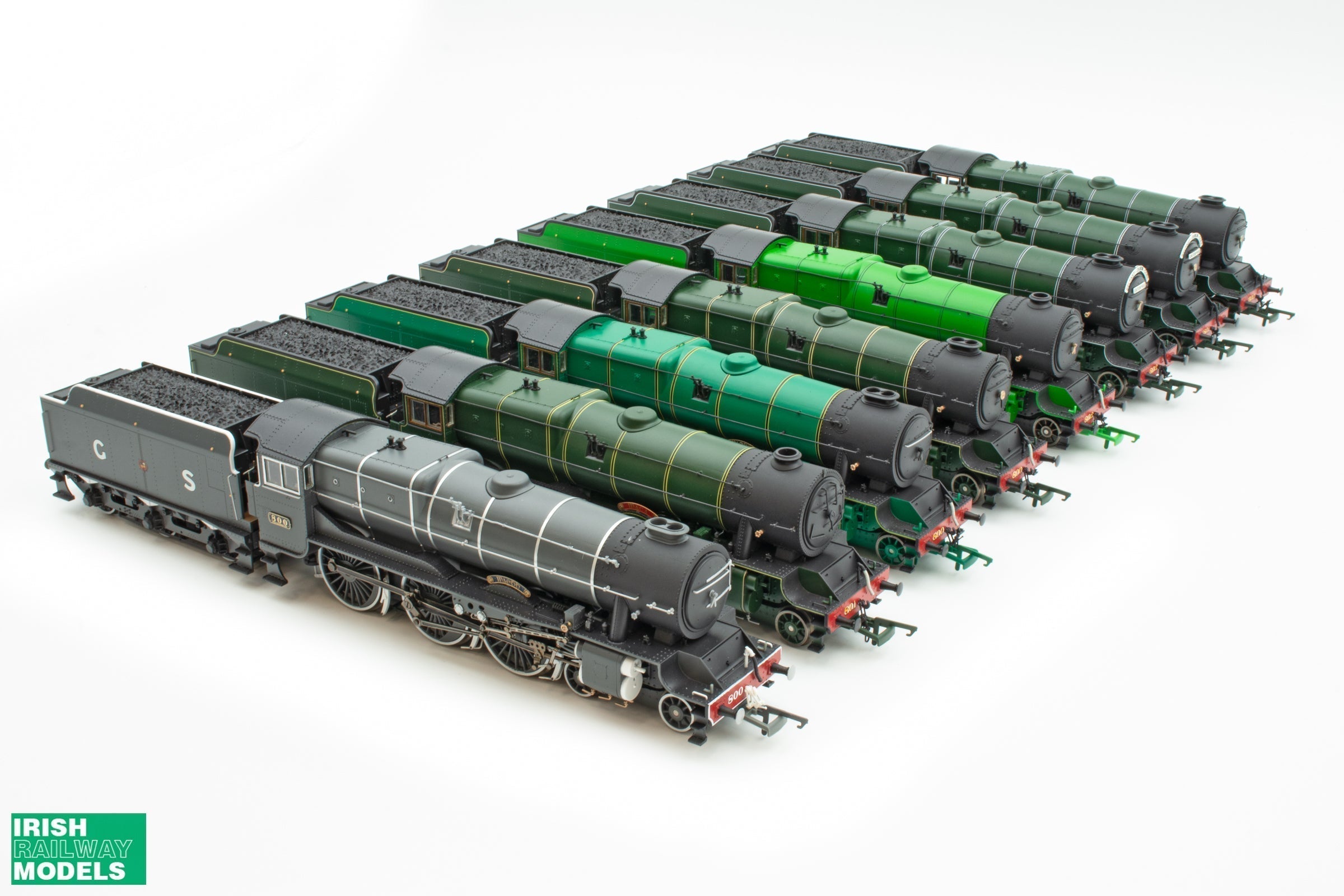
We’re delighted to report that our GSR / CIE 800 class has now reached the decoration stage, and we’ve been taking a close look at the latest samples.
We just had to share them with you all!
This stage is all about fine-tuning — confirming what’s working well and making sure anything that needs improvement is picked up early, before we move towards production.

Overall, the models are in very good shape, but there are a few areas we've identified where refinement is needed. This is all part of the production process!
To improve overall fit and consistency, we’ll be adjusting the painting process so that parts are painted as sub-assemblies rather than as individual components. This should result in cleaner joins and a more robust final assembly. Along similar lines, the fit of the handrails will be improved so they sit more naturally on the finished models.

We’ve also noted that the running gear is currently a little too loose for our liking. This will be tightened up to give a more accurate and solid feel. In performance testing, the motor and gearbox behave exactly as intended in most situations, but when hauling a very heavy load — around ten bogie coaches — there is a small drop in performance. We’re targeting roughly a ten per cent improvement here to fully meet our specification.

On the decoration side, the cab and tender etched plates were fitted to these samples in error. On the production models, cab side and tender numbers and crests will be tampo printed as intended, with separate etched plates supplied in the accessory bag where applicable. We’ve also identified a few areas where paint coverage and accuracy can be improved, and the quality of the boiler lining will be further refined to give a crisper finish.
Our Project Manager is looking afresh at historical evidence and the livery carried by 801 on ACC-1302/ACC-1310 during its single chimney period of 1954 - 1961, when the tender was devoid of its ‘Flying Snail’. This may lead to the lining being removed completely.

A couple of detail points have also been flagged. The orientation of the drain cocks is incorrect on several samples, which has been noted and will be corrected. In addition, metal parts such as axle ends and wheel pickups have not yet received chemical blackening — this will be applied to improve realism.

The tender’s rear NEM pocket also needs a little fettling to increase the range of movement, and the bright tension lock couplings will be replaced with black or dark grey versions. We may also supply alternative transparent ABS couplings, which is still to be confirmed.
Just as importantly, there’s a lot of positive news to report.

The decoration samples have met, and in some areas exceeded, the original artwork specifications, with colour matching in particular proving to be spot on. Each model has also been fitted with the correct variations of chimney, smokebox, and smokebox door — something that isn’t always guaranteed at this stage, but very welcome to see.

From a running perspective, aside from the slight loss of performance under very heavy loading, the motor performs to specification and the gearing is exactly where it should be.
The transition from a slow crawl through to express speeds is smooth and convincing. Initial generic DCC and sound testing has also gone exactly as expected, allowing us to move confidently towards the development of the fully tuned DCC and sound-fitted versions.
 All of this feedback has now gone back to the factory, and we’ll be keeping a close eye on the next stage as these refinements are implemented. We’re very encouraged by how the 800 class is shaping up and look forward to sharing further updates as the project continues.
We're still on track at this moment to meet our expected delivery date of Q3 2026. Just look at this detail and quality, on a model of a locomotive designed and built in Ireland. All of this replicated in miniature for the first time in high quality, ready-to-run format, and possibly never to be repeated.


