

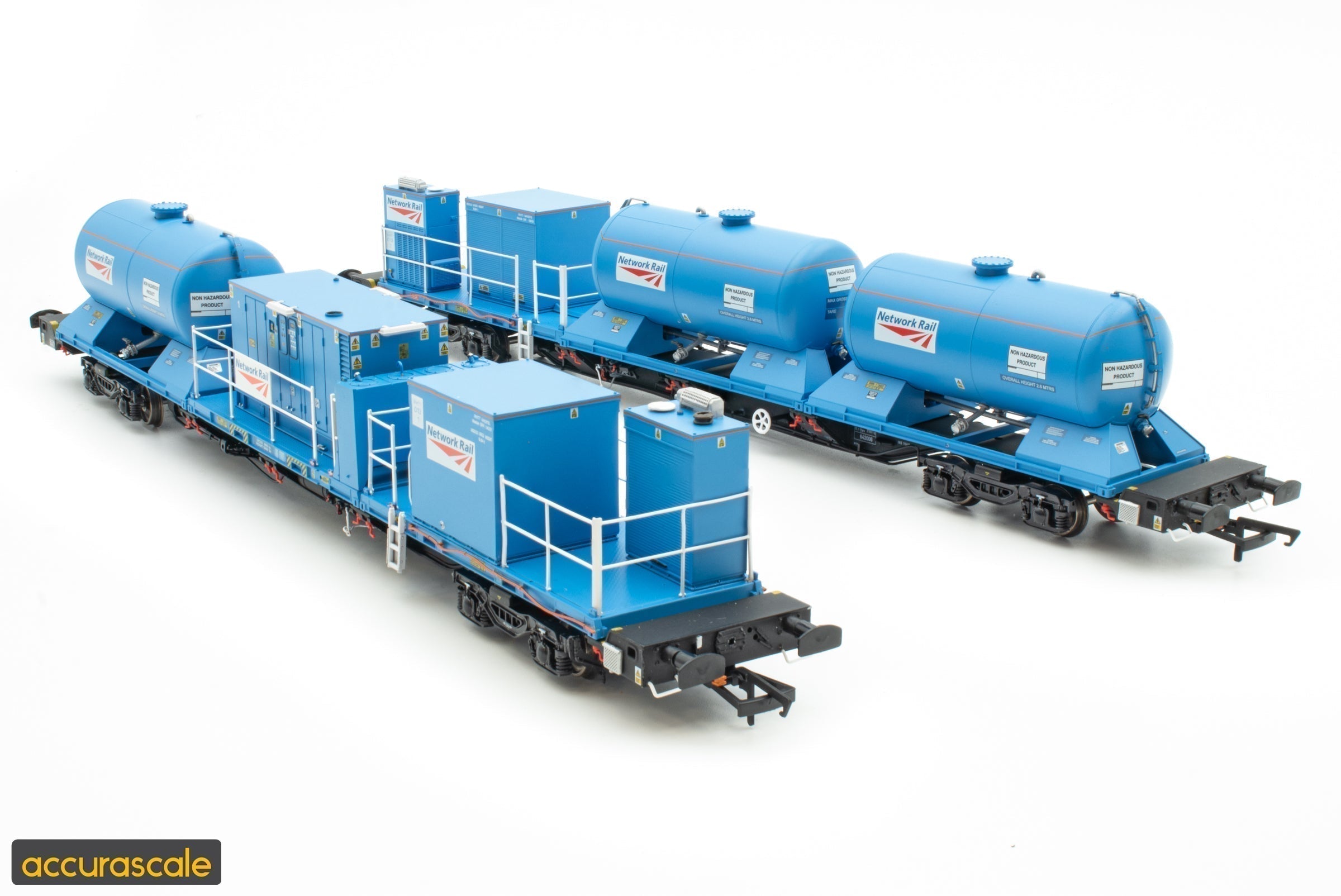
In an announcement that will surprise absolutely nobody, we can finally reveal the next release of former Hattons tooling which has now been warmed over and promoted to the Accurascale range.
Welcome, to the much loved and oft demanded Railhead Treatment Trains!
Prototype History
 The 2005 railhead treatment train (RHTT) season saw the introduction of a new purpose-built FEA-F wagon type that completed Network Rail’s transformation of its loco-hauled RHTT services from an ad hoc collection of second-hand vehicles into a fleet fit for the leaf-busting needs of the 21st century. The 50 module flats, with 60ft platforms, were constructed in Poland by Greenbrier Europe’s Wagony Świdnica plant and were derived from the already ubiquitous single- and two-unit FEA container wagons that were either already in use or on order for Balfour Beatty, Fastline Freight, Freightliner, GB Railfreight and Transplant.
Numbered 642001–642050 and configured as ‘singles’, the FEA-Fs were fitted with through wiring for top-and-tail operation with locomotives equipped with either AAR or Blue Star/DRS 27-way multiple working. They were designed to carry various modules introduced in 2003/04 and would enable Network Rail to retire the ageing General Utility Vans and TTA water tank wagons that had been such a feature of these services since the 1990s.

The first to be withdrawn were the TTAs, which were replaced in 2003 with one or two KFAs, each carrying three Protran Developments 17,100-litre water tanks, providing around 180 miles of water-jetting capability per wagon. The following season, the GUVs were retired in favour of another KFA equipped with a Woma 1,000–1,500 bar water-jetting module, supplemented on some routes by a pair of Socofer-built Sandite applicator modules. These were originally limited to 40 mph operation, but since the adoption of a new formula can now operate at 60 mph.
The monopoly of traction provider English Welsh & Scottish Railway also ended in 2004, as Direct Rail Services and GB Railfreight were both contracted for certain diagrams. It was also the swansong for the EWS Class 37s, which were replaced by Class 66s and 67s the following year. The first year of the FEAs in 2005 was marked by a reversal of roles, with DRS taking the lion’s share of the circuits. These included the use of Class 20/3s in East Anglia and the North East and West, alongside its Class 37s and 66s.

The new FEA-based formations comprised a water-jetting module (powering a spray head on the inner ends of one bogie) with a minimum of three water tanks. Around two-thirds of the trains were also configured with two Sandite modules positioned at the outer ends of the FEAs (with application nozzles at the outer ends of the bogies), while ‘water-only’ routes replaced these units with additional water tanks. In some years, one or two long-distance diagrams required a third FEA to carry extra water tanks, particularly from Wembley, along the North Wales coast and to Carlisle.
For 2007, the water-jetting nozzle and associated pipe run were rerouted to the inner end of the opposite bogie, placing both water and Sandite applicators on the same bogie. That year also saw Colas Rail enter the scene with a new circuit in Devon and Cornwall, while the following year saw EWS (later DB Schenker/Cargo) employing its silver Management Train Class 67 and DVT on a Midland Main Line diagram. Since then, several other operators — including Europhoenix, Freightliner, Harry Needle Railroad Company, Locomotive Services and West Coast Railways — have been involved with these trains, either through direct contracts or by providing traction for hire.

For the 2009 season, the water-jetting module was modified with a larger fuel tank to increase its range. In 2013, further examples of all three modules were ordered as Network Rail expanded its loco-hauled operations with 12 ex-Avon County Council KFAs. These were refurbished at York Holgate Works, which maintains and overhauls the wagons during the off-season, and were primarily intended for use on the third-rail network based at Tonbridge West Yard.
For the 2025 season, the contract to operate the 29 trainsets was split between Colas and GB Railfreight, with motive power selection remaining as eclectic as ever. As well as their own and hired-in DB Cargo and Freightliner Class 66s — the latter providing trip-cock-fitted examples for use between Marylebone and Aylesbury — Colas rostered its Class 37s, 56s, 67s, 70s and Network Rail Class 97/3s, while GB Railfreight also leaned heavily on its Class 57s, 69s and 73s.
The Models

Our model introduces several notable enhancements and robustness upgrades over the previous Hattons release. While the decorated samples on display use the original tooling due to the lengthy sample creation process, the moulds have since been revised to allow both water pipe run configurations, as well as the original version of the water-jetting module before it gained the longer-range fuel tank.

Less obvious changes include the reorientation of the module locking levers and the removal of the rectangular holes in the deck, which are only found on intermodal versions.
Our first production run will cover the post-2009 period of FEA-F operations and will include four twin packs: two covering water-only circuits (642013/40 and 642018/21) and two covering Sandite/water circuits (642006/47 and 642009/32).
Price, Availability and Delivery

Each twin set is priced at £149.99, which is a £25 saving on RRP when inflation is taken into account, representing excellent value once again for this staple of the current scene (albeit in the Autumn and winter months only!)
Delivery is slated for Q2 2027 and like previous ex Hattons releases only available direct via the Accurascale website.
Pre-order yours today, with no money down, or via flexible payment terms are no extra cost on our website by clicking the link below!


