

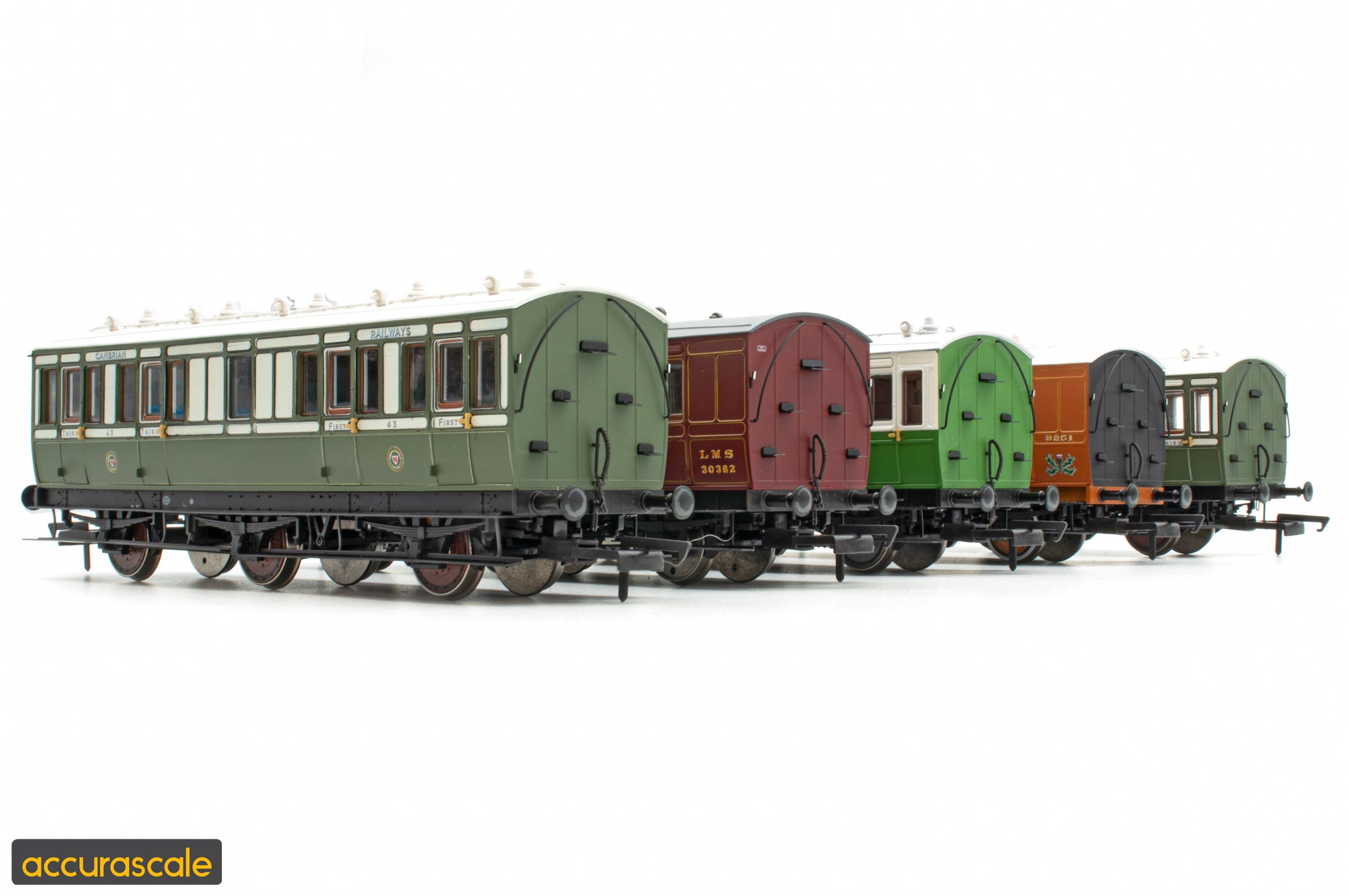
It is probably fair to say that the Genesis coach project was one model range from the Hattons stable which may not, at first glance, fit with the Accurascale ethos.
However, with the tooling suite now under the ownership and investment of Accurascale, and being produced in a new, dedicated factory, the future for the Genesis range is very bright indeed and is now benefiting from a new approach: “The Accurascale Way”.

So the question has to be: how will an Accurascale-produced Genesis model fit into the range, and what shape will any future investment in the tooling take?
The answer lies in research. Just because model features are generic does not mean that the decoration or train compositions have to be.
Our aim, will be to provide realistic rakes of rolling stock in liveries that are as correct in detail as possible in 4mm scale, and to push the boundaries of what is achievable with decoration.
Feel this post is a bit "TLDR"? Then let the dulcet tones of our Project Manager Paul Isles explain it in our video below!
The Challenge

The process of saving a tooling suite and transferring it to a different factory for manufacture presents its own challenges, not least potential damage to the tools and compatibility with that factory’s injection equipment.
The process begins with identifying all the parts, making test shots and creating new metal components to replace those that do not come with the tools. Some degree of fettling will be required to improve fit and eradicate ejection scars, while other parts may need complete replacement.
The First Upgrades
The first run of a transferred tooling will always, by necessity, be one of consolidation, but we have still added a few modifications from previous iterations. The lighting has been modified so that it is now a permanent feature rather than optional, with lights being track-powered (not DCC-controlled) and switchable by magnetic wand. We have also added stay-alive to the lighting PCB to improve performance over uneven or dirty track sections.

A new body style has been added to the 6w stock, with the Full Brake now featuring centrally placed duckets rather than offset ones, to reflect a wider range of prototype Full Brake body styles.
The First Range
So, having set the scene for this range of 4w and 6w coaches under the new Accurascale Genesis branding, let us take you through the history of the various liveries and rake compositions in this new run.
GREAT EASTERN RAILWAY – 4w COACHES

On 6 February 1919, the Great Eastern Railway’s Locomotive Superintendent, Albert Hill, presented his report on replacing varnish as a coach finish with paint, his preferred colour being Crimson Lake. With Board approval, this was implemented by April 1919.
Body sides and ends, along with solebars and headstocks, were painted Crimson Lake, with all running gear below solebar level being black. Mansell wheel centres were painted either Crimson Lake or black. Roofs were painted white or off-white, along with all roof furniture; however, the section of roof between the lower rain strip and the eaves was painted mid-grey. Body mouldings were picked out in cream or primrose lining, and a new serifed lettering style was adopted, along with smaller class numerals on door panels where possible.

Being suburban stock, these carriages did not carry the GER armorial device, but First and Second Class vehicles were denoted by broad colour bands beneath the eaves: chrome yellow for First Class and French blue for Second.
All trains for the GER’s new suburban timetable of the period, the “Jazz” services, were made up of 16 vehicles, and we have chosen to represent vehicles from the Enfield Sets for this release. To enable short trains to be run, the 16-car rake was split between the 10th and 11th vehicles, creating 10-car and 6-car portions. The sets were lettered at each end, with “EE” for the 10-car portion and “E” for the 6-car portion, with an additional letter A, B, C, etc. denoting the individual set.
Initially, Enfield Sets were split as 12-car and 4-car portions, but this was soon abandoned in favour of the 10/6 split. The running order was:
3rd Brake, 3rd, 3rd, 3rd, 3rd, 3rd, 2nd, 2nd, 2nd, 2nd, 1st, 2nd, 2nd, 1st, 3rd, 3rd Brake.
The portions were divided between the 2nd Class coaches for the 12/4 split and between the 2nd and 1st for the 10/6 split. Packs A and C form the early 4-car portion, with Pack B adding the two vehicles required for the later 6-car portion.
METROPOLITAN RAILWAY – 4w COACHES

To provide stock for the new extension to Aylesbury, the Metropolitan Railway ordered 32 four-wheel carriages from Cravens, which entered service in 1892. Intended to serve both Aylesbury and Chesham, the eight-car rake was split into two four-car sets, each comprising a 2nd Brake, 1st, 3rd and 3rd Brake. The two sets were divided between the 3rd Brake and 2nd Brake. All eight sets ran in the timetable until 1905, when they were sold to the Weston, Clevedon & Portishead Railway and the Nidd Valley Railway, with the remainder retained by the Metropolitan as reserve stock.
The general finish was varnished teak bodies, with solebars and headstocks painted to match and running gear below solebar level painted black. On First Class vehicles, the upper section of the body above the waistline was white under varnish, resulting in a creamy finish. Mansell wheel centres were also painted to match. Roofs and roof furniture were painted white or off-white.

Body mouldings were generally picked out in gold or straw yellow, apart from the First Class upper panels, which were outlined in light blue with an even thinner vermilion lining. Where possible, carriage lettering and numbering were arranged symmetrically, with class markings centred on the doors. The Metropolitan armorial device was placed either beneath the vehicle number or centrally beneath the company legend if that appeared on a waist panel.
CAMBRIAN RAILWAYS – 6w COACHES

Centred on Oswestry, the Cambrian Railway operated only 230 miles of standard-gauge track but covered a very wide area, encompassing central and coastal Wales and including associated narrow-gauge lines such as the Vale of Rheidol, Welshpool & Llanfair, Corris, Ffestiniog and Talyllyn Railways.
Between 1883 and 1909, the standard Cambrian coach livery was bronze green on the lower panels, coach ends (apart from brake ends, which were vermilion until at least 1911 and possibly until 1915) and upper body beading. The waist and upper panels were white under varnish, giving a creamy tone. Solebars were black, with all running gear below also black. Mansell wheel centres were an unusual red-brown colour.

Panel lining was gold with black edging, with ultra-thin vermilion lining introduced later. The Cambrian armorial device appeared twice on each side of the 6w stock, with company legend, class numerals and coach numbers in gold sans-serif characters, blocked in dark blue, light blue and white.
LONDON NORTH EASTERN RAILWAY – 6w COACHES

For the LNER, we have moved away from passenger use to represent alternative applications of inherited 6w stock after Grouping.
The Scotsman newspaper was first published in Edinburgh on 25 January 1817, but railway distribution did not become widespread until stamp duty on newspapers and advertising was abolished in 1855. The proprietors of The Scotsman entered into an arrangement with the Scottish railway companies, agreeing to pay carriage fees themselves, thereby creating a railway distribution monopoly. Circulation increased rapidly, reaching around 40,000 copies per day by the early 1870s.

This growth led to the introduction of dedicated early-morning newspaper express services in partnership with the North British Railway, using special vans to convey papers from Edinburgh at 04:00 to Glasgow for onward distribution. By 1899, a further service to Hawick was introduced, connecting with the 06:00 Riccarton passenger train and allowing early delivery to towns such as Hexham, Langholm, Carlisle and Newcastle.
These services ran for over 70 years, with little operational change, until the mid-1940s. Bundles were loaded at Waverley into twelve dedicated vans in Scotsman livery. Packers sorted parcels en route, throwing them onto platforms at intermediate stations as the train slowed to around 10 mph.
Under the LNER, the vans were repainted from NBR Coach Lake into painted teak body colour, with ends black after 1925. Solebars and wheel centres were also teak-finished, with running gear black. Panel lining followed standard LNER practice in primrose yellow. The Scotsman heraldic banner appeared on both sides, with thistle emblems at each end.

For our second LNER offering, we move to the 1930s and the growth of leisure travel. In 1933, ten former Great Northern 6w coaches were converted into Camping Coaches and located at branch line sites. Three compartments became kitchen and living space, with two converted into bedrooms, accessed externally via the running board. Toilet facilities relied on station amenities.

The scheme proved popular, with 129 bookings in the first season at £2 10s per coach per week, on condition that guests travelled by rail. By 1938, 118 coaches were in use across England and Scotland. In 1935, the original teak finish was replaced with green and cream Tourist Train Set livery, and “Camping” was replaced by a CC prefix to the coach number. Touring Camping Coaches were also introduced, moving between locations with their occupants aboard.
LONDON MIDLAND SCOTTISH RAILWAY – 6w COACHES
Our final offering covers the use of 6w vans as Mail Bag, Parcel Tender and Stowage Vans in LMS Travelling Post Office trains of the 1930s.

Like locomotive tenders, these vans carried unsorted mail and parcels collected en route. Originating largely from Scottish and north-western areas, many were inherited from Midland and Highland Railway designs and retained their distinctive offset gangways.

Following Grouping, the LMS replaced time-expired stock on a one-for-one basis, resulting in a wide variety of diagram types. Interiors were generally spartan, though some included cupboards, lavatories and ovens. Two Stanier designs were exceptions; one of these, Diagram 1867, lacked interior fittings and a gangway connection, and forms the basis for our model in this run.
Price and Availability
With the range now at decoration stage, it is our aim to commence production after Chinese New Year next month, giving a delivery date of Q4 2026.
Even with our upgrades, particularly around the PCB and new tooling for the Full Brake, you can still obtain excellent value with our Genesis coaches. With twin packs offered and including our 10% and 15% bundle deals, you can acquire these models from just £33.99 per coach.

Delivery is scheduled for Q4 2026.
As with the majority of our ex-Hattons models, to offer maximum value we are making these direct-only models via our website.
The Future

In time, we will add new body, roof and interior types to the tooling suite to cover a greater range of coach builds, and we will be making the most of the scale 28’ 4w and 32’ 6w underframes over the coming months. In due course, we may even add more prototypical stock that utilises these underframe lengths.
It may also influence, or be influenced by, our future steam locomotive model output.
Pre-order the first run today via the link below!
Pre-Order Your Genesis Coaches Here!
As with all our projects, many third parties have contributed to the research, particularly for liveries. We would like to thank Keith Crombie, Allan Rodgers and the North British Railway Study Group, along with Ian MacCormac, Adrian Marks and the Great Eastern Railway Society, for their invaluable assistance in ensuring the liveries represented are as accurate to the prototype as possible.


